
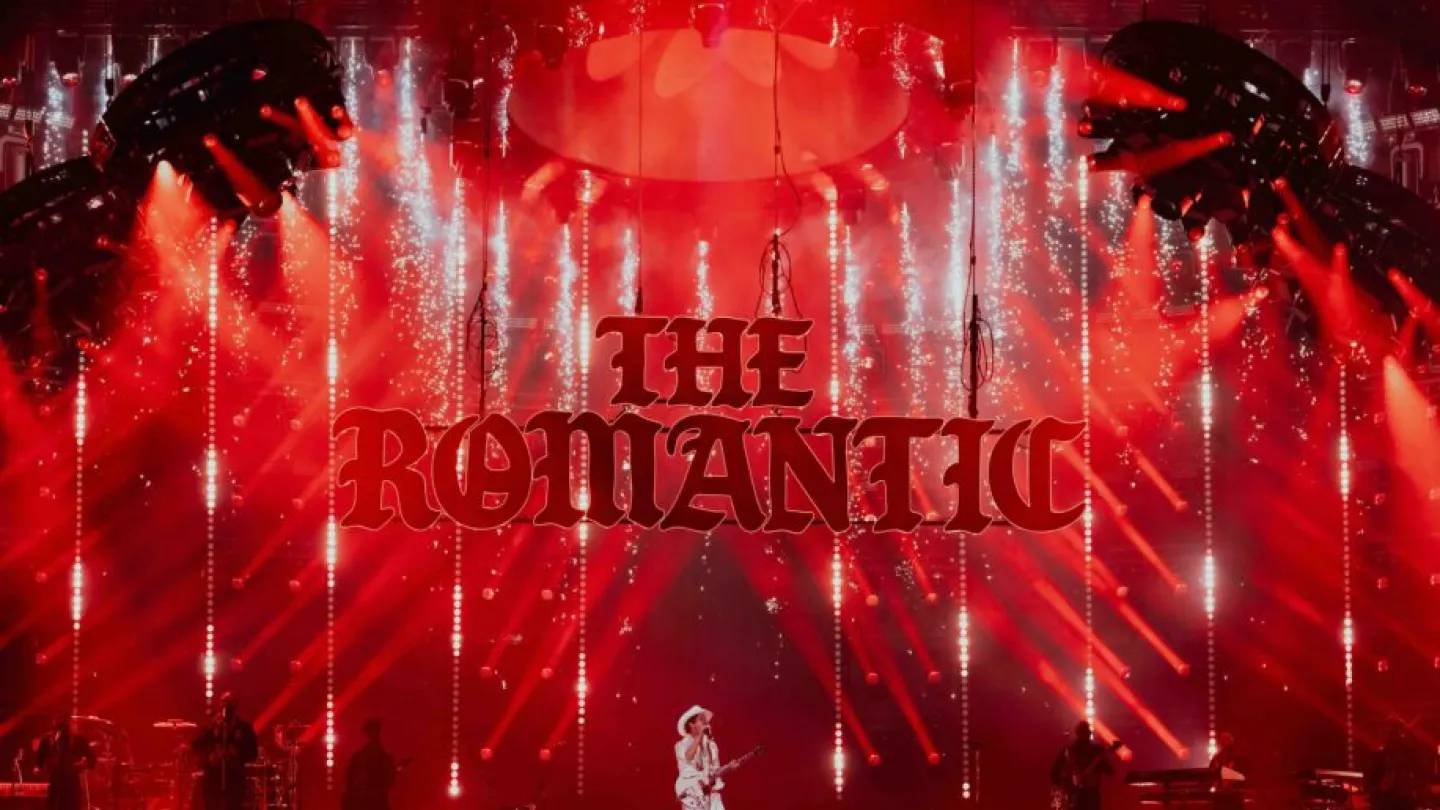
Bruno Mars' first full global tour since 2018, The Romantic Tour, is about to leave British shores, having kicked off in April from Las Vegas on its first North American leg, before transferring to Europe throughout June and July. After a short break it returns to North America from August to December, clocking up 71 dates in all, with the prospect of extending far into 2027 and beyond. It has become one of the biggest stadium tours of 2026, setting Live Nation's record for the largest single-day ticket sale with 2.1 million tickets.
Adding to the dynamism of Mars' energetic, high-octane 30-song show are 212 Ayrton Rivale Profiles and 40 Ayrton Veloce Profile fixtures, chosen by lighting designer Whitney Hoversten in a very stringent selection process: "Atremendous amount of thought went into the fixture choices," he explains. "It's all about having the right products to do the job the artist wants, and Bruno is very clear about how he wants the show to look and feel."
Hoversten knows better than most about the wishes of Mars as he has worked with him for over ten years, and it is a collaboration that shines through in his lighting design. Hoversten's intimate knowledge of Mars' music forms a powerful synergy, with every beat and nuance highlighted in light until it manifests as an extension of Mars' voice and dance moves, becoming an additional instrument and another dancer as active as the adept artist himself. Dynamic and fast moving and rarely still until the softer numbers, the lighting rig had to be as adaptable as the performer and the music.
"We had the tricky task of devising a completely new rig that would be ready for anything, capable of expanding on old looks for the back catalogue and creating fresh new ones for the new numbers, many of which were created during rehearsals," explains Hoversten. "It was a fast and organic process and we needed a Swiss Army Knife of a fixture to besure we had all the tools to deliver everything that would serve Bruno needs."
Working closely with production manager, Joel Foreman, and the lighting team, Hoversten developed and streamlined the lighting elements, integrating them into the set design.
The Romantic set is a highly mobile configuration comprising ten rotating truss pillars each rigged with 14 Rivale Profiles, six of which track on and off stage behind Mars, and four non-tracking rotators that flank him either side of the stage. Two mini ladders – half size copies of the rotators – are located in downstage positions and rigged with 7 Rivale Profiles. The set is constantly on the move, reshaping the performance space, continually keeping Mars in the best light and following his movements like another performer in the troop.
Overhead, a circular video screen – named the Puck – is outlined with 10 Rivale Profiles and 4 circular dynamic pods carry 12 Rivale Profiles on each. These change the shape of the performance space, provide dramatic surround lighting for drum solos, a multiplicity of aerial beam looks and an additional layer of texture and depth. Upstage of the video wall are 40 Veloce Profiles on ladders, spaced to mimic the rotators in front of them. These do everything the Rivales do, but with the added punch to get through the screen and augment the video content without revealing the lights behind or washing out the content.
The result completely surrounds and backs Mars within the proscenium area with active Ayrton fixtures integrated into the moving set. Hoversten's lighting determines the shifting ambience, keeping pace with Mars as his music transitions from ballads and soulful grooves to retro-funk and rock.
"The Ayrton fixtures are a very dynamic part of our design," states Hoversten. "We are using the majority of the feature sets: a lot of songs use gobos and animation wheels and we love all the gobos in them. You need big bold looks for stadiums, so we often use them open with narrow or wide beams, plus there's a lot of dimmer effects and strobing. We even introduce the prisms at times – I doubt there is a feature in them that we are not using!"
Expanding on his criteria for choosing Rivale and Veloce Profiles, Hoversten says: "I've used Ayrton many time before but this is the first time I've used Rivale and Veloce. All our lighting choices were grounded in what was the best for the show, and gave us the most options. Weight and size were a huge consideration because of the size of the set, wind rating at the outdoor venues, and the dynamic load from the number of moving elements. One of the most difficult engineering projects was the Puck that tracks up and down stage, and lowers to a vertical position with the weight hanging on just a couple of points. Rivale's light weight at 30.8kg and compact size fitted the bill as well as the set, and were a major factor in our decision.
"One of the main feature sets that I love most is the continuous pan and tilt that comes in so many of the Ayrton fixtures, including both Rivale and Veloce. That whittled down a lot of the options and fitted exactly with the kind of visuals we were aiming for.
"We needed lights that have enough horsepower for stadiums, and I was very particular about the aperture size and the front of the fixture: Rivale's large lens is signature to the look and functionality of the pillars and the lighting pods. One show in Toronto had virtually no haze because of the strength of the wind, yet the show still looked fantastic because you could still see the effect of the light when it was doing its dimmer chases, hits etc. I attribute that to that big source on the front of Rivale and the intensity it brings for stadiums.
"Rivale has so many features and options which really impressed me, but it's also a really good quality light for lighting the performers! It is so versatile: I can switch from beams to graphics to spinning movements in a moment, then instantly transform it into a lightsource for the artist or band members with all the subtlety and colour mixing that entails. It's a very flattering lightsource for the human body. It's a great tool and the Swiss Army Knife we were looking for."
Hoversten also liked the fact Ayrton has a large, medium and small option in each fixture range – Veloce, Rivale and Stradale in this case. "It gives you the ultimate flexibility and uniformity of choice," he says. "The reason we have the 40 Veloces behind the video wall is they have the exact same features at Rivale. It was a great opportunity to combine the extra foot candles of Veloce with the exact same feature set as Rivale, giving us more punch to get through the video wall when needed.
"We've ended up with a show that looks and feels massive and I'm super-happy," he concludes. "Bruno was intensely involved in the whole creative process, sitting for 14 hours a day for 2.5 weeks with the programmers, articulating just how things look like in his mind as he wrote the music, what he wants it to feel like when he is performing on stage and translate across to the audience. He was so thrilled with the tools we had in the tool box and what they could do. It was such a fun process to help him put this show together and he is very happy with how things turned out. I really love the show that we have and are delivering to the world."