
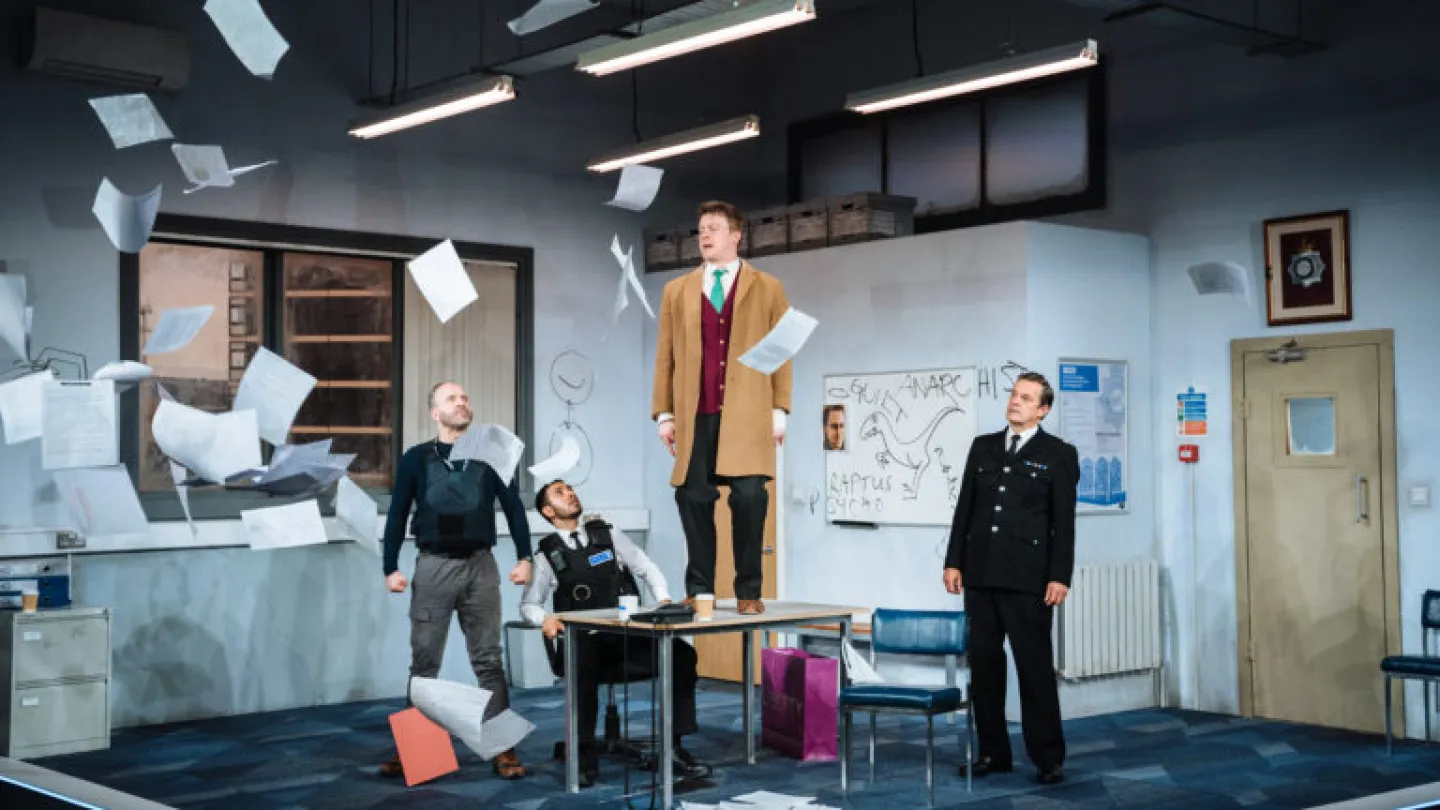
First performed in 1970, Accidental Death of an Anarchist is a classic farce by Italian playwright Dario Fo. Last year, it was revived in a brand-new production at Sheffield Theatres, which then moved into the Lyric Hammersmith and now finds itself arriving at the Theatre Royal Haymarket in the West End; just over forty years since its initial London run. This latest version features a lighting design by Jai Morjaria, who approached White Light (WL) to supply his lighting equipment for every stage of this latest production.
Accidental Death of an Anarchist explores the story of an anarchist who falls to his death from a police station window. As the police scramble to avoid another scandal, a mysterious imposter is brought in for questioning. With an opportunity to put on a show, he leads the officers into an absurd reconstruction of their official account, revealing the cover-ups and idiocy at the heart of the police… Speaking about his creative brief on the show, Jai comments: “The entire show is set in a police station so we wanted to ensure the whole aesthetic felt naturalistic. The lighting therefore had to be crisp, sharp and incredibly bright; in fact, it’s probably the brightest design I’ve ever done. The lighting plays a huge role in highlighting the various twists and turns that are unveiled as the story progresses. As such, the quality of naturalistic light and what we’re perceiving as the ‘real world’ becomes even more important to the narrative”.
He adds: “Another part of the brief was to make the set appear as if it was levitating. We almost wanted to make it feel as if it was a cube placed within an empty space, which required a very precisely focused rig. Of course, during the rehearsal and technical period, the show evolved and we were constantly making changes. But, for me, that’s the exciting part of putting a show together; especially one as twisty as this”.

This particular revival has been on a unique journey; in that it has gone from a studio space, to a mid-scale theatre to now a West End venue. As such, Jai had to adapt his design every step of the way. He comments: “The show’s first ran at the Tanya Moiseiwitsch Playhouse at Sheffield Theatres; the first production to be staged there following its renaming (it was previously called The Studio). Given the smaller scale, we mainly used the in-house rig; though we did also hire in some moving lights. This included Aytron Diablos and Martin MAC Quantum Washes, which proved invaluable as bright spotlights that could fight through the general cover of the stage-wash. As previously mentioned, my design for this show was much brighter than normal so I needed something extra punchy. It’s worth noting that the brilliant set design by Anna Reid consists of two walls and a roof so the show comes in at 45 degrees as it faces the audience. As such, all of my fixtures had to come in as part of the set and be as discrete as possible”.
Following a highly-successful and critically-acclaimed run in Sheffield, the show transferred to the Lyric Hammersmith where Jai would have to adapt is design. He comments: “The main house in the Lyric Hammersmith is much bigger than the Playhouse in Sheffield so we needed to accommodate this. The first alteration to my rig were the MAC Encore Performance Colds. This was a great decision as they provided the looks I needed but were also deceptively quiet. They also allowed us to do an incredibly tight iris from the back of the auditorium. We added Concentric circle top hats to the GLP X4XLs (which were in place of the Quantum washes) to reduce the flair. For the stage-wash, I used a mixture of in-house ETC ColorSource Profiles and Source Fours; the combination providing the exact balance we needed”.
As in Sheffield, the run at the Lyric proved to be a hit with audiences and critics alike – and soon the West End beckoned. The show would mark the second West End production that Jai has designed this year; following My Son’s a Queer (But What Can You Do?) at the Garrick Theatre. Speaking of the transfer to the Haymarket, Jai comments: “The most obvious difference was that the Haymarket is an even bigger auditorium than the Lyric so I tried to increase with brightness of units rather than the size of the rig; With that in mind, I drew on the ETC Source Four Lustr 2s, as well as the Ayrton Perseos and the Martin MAC Aura XBs, which were positioned in every corner to adapt the design for the new FOH positions in the Haymarket”.

As with most productions, Accidental Death of an Anarchist wasn’t without its artistic and practical challenges. Jai explains: “The set itself had a large cyc through a window which was significant to the story telling; thankfully, the ETC ColourSource Vs with specific cyc lenses ensured the finish was completely smooth. I also had to mostly front light the show due to a low hung ceiling and walls, so we were conscious about having shadows on the set. Another challenge was the fact that every time the show moved venue, we would encounter a new front-of-house – something that was slightly problematic given this was our primary source of light! It was then a case of discussing, adapting and ensuring that whatever we did, the lighting had the depth and definition which the show depended on otherwise it would have been very easy to make this show look flat – and no one likes a flat show.”.
Accidental Death of An Anarchist opened earlier this month to critical acclaim. It runs at the Theatre Royal Haymarket until 9th September 2023.
The Lighting Team
Elliot Smith – Lighting Programmer
Barry Abbotts – Production Electrician
James Bentley – 2nd Electrician
Luca Panetta – Lighting Draftsman
Steve, Andy and James – In-house Electrics team
The post White Light Responsible for Accidental Death of an Anarchist appeared first on White Light.