
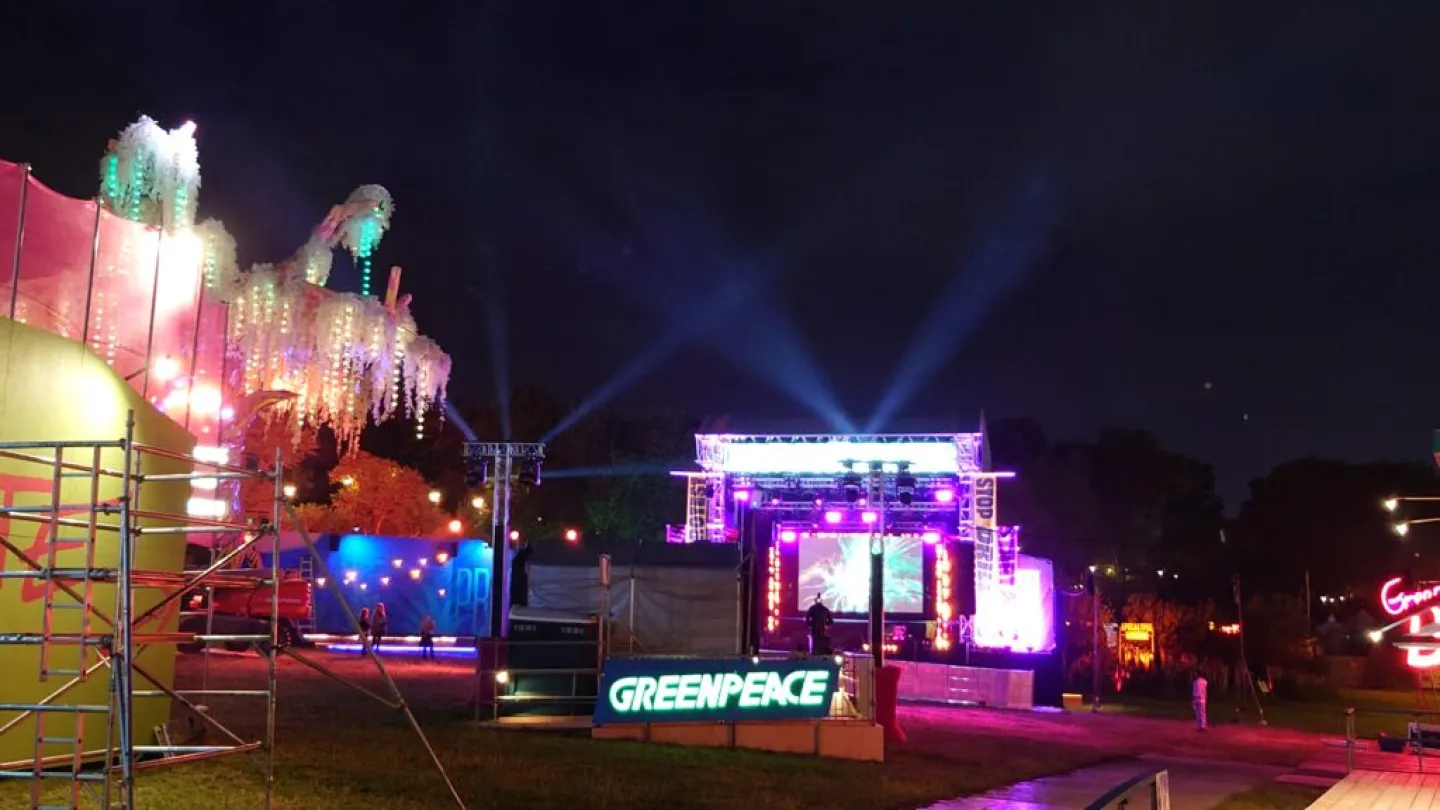
As Glastonbury prepares for its upcoming fallow year, the Greenpeace field took on a special significance in 2025. With the promise of a large-scale redesign on the horizon, this year’s creative vision was all about celebrating the iconic elements that have defined the space, and most notably, the beloved Rave Tree.
A Tree That Dances
The Rave Tree has always been a beacon within the field, but this year, Lighting Designer Tom Tomkins used it as a stage in its own right. With a limited budget and a strong desire to make the most of every resource, the creative team leaned into creativity over quantity. By trimming down the main stage lighting, they were able to reallocate fixtures to the tree itself, transforming it into a luminous centrepiece that demanded attention.
Tom comments: “We installed two rigging positions on either side of the trunk, each fitted with Ayrton Perseos, sending powerful beams slicing through the night. We also introduced additional FOH towers, equipped with Perseos and Martin Mac Aura XIPs, not only casting light on the tree, but on the crowd gathered beneath it, bringing them together.”
The lighting design was anchored by a trio of key fixtures: Ayrton Perseos, Ayrton Diablos, and Martin Mac Aura XIPs, supplied by White Light (WL). Not only were these chosen for their performance, but for their resilience. With many fixtures exposed to the elements, IP ratings were essential. The Diablos, used onstage, paired seamlessly with the Perseos, offering a punchy, efficient light source.
To add texture and depth, Chauvet Colorado PXL Bar 16s created a pixelated light curtain behind the stage. Meanwhile, Lumpix 15IP Battens framed the video wall with four vertical columns, echoing the visual content and adding a layer of “eye candy” without overwhelming the space. And of course, no festival setup would be complete without the dynamic energy of Chauvet Color Strike Ms, delivering strobe effects and pixel-mapped visuals.
Lighting the Tree: A Technical Balancing Act
One of the most unique challenges? Tom comments: “Lighting the tree without compromising its natural beauty was the most unique challenge we encountered. Early ideas to place fixtures in the branches were quickly ruled out—leaf decorations would have tangled with moving lights. Instead, the team opted for a more subtle approach: fixtures placed on the trunk, high enough to be effective, and low enough to avoid interference. Inside the trunk, Lumipix battens created a warm internal glow, while Aura XIPs shone through cut-outs, giving the tree a heartbeat. The addition of the Perseos brought a new level of interactivity, allowing the tree to reach out and connect with the crowd.”
Sustainability at the Core
As always with Greenpeace, sustainability wasn’t an afterthought, it was a guiding principle. Every element of the field is designed for reuse, with materials from previous years reimagined and redecorated to fit the current vision.
The lighting rig was entirely LED, keeping power consumption low. Fixture outputs were limited where possible, and the switch from Mac Quantums to Ayrton Diablos saved 200 watts per unit—without sacrificing impact. New rigging positions were designed to make each light multifunctional: illuminating the stage, the tree, the signage, the crowd, and even drawing people in from afar.
WL’s Head of Lighting Dom Yates comments: “As a company committed to minimising the environmental impact of our operation, it is an honour to work with Tom and the team supplying lighting fixtures that make a difference. Our wide and versatile fixture inventory enables LD’s sustainable vision.”
In a year of transition, the Greenpeace stage stood as a glowing reminder of what’s possible when creativity, sustainability, and technical ingenuity come together. The Rave Tree didn’t just light up the night—it told a story. And next year, as the field rests and reinvents, that story will echo in the roots of what comes next.
The post Blog: Behind the Vision of the Greenpeace Stage at Glastonbury appeared first on White Light.